


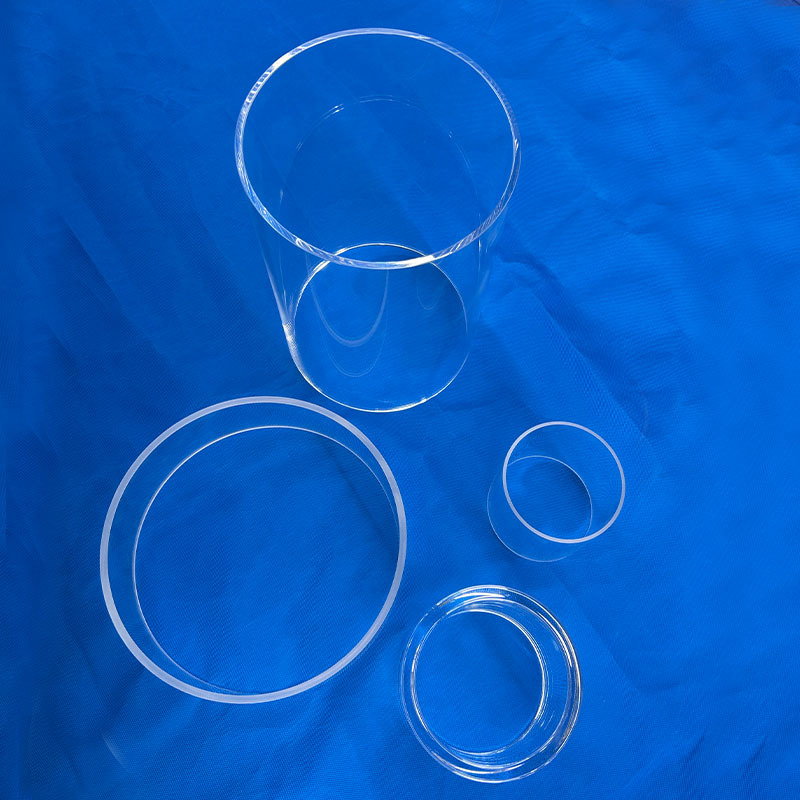
Custom High-Purity Polishing Transparent Quartz Tube-Mia
Published On: June 23, 2026
This case covers a material upgrade project for a US-based laboratory equipment wholesaler. The client supplies heating and reaction equipment for university chemistry labs and semiconductor wet-processing facilities. Facing persistent sample contamination and unreliable test data caused by traditional borosilicate glass tubes in high-temperature ultra-clean experiments, the client partnered with us to validate and fully switch to high-purity quartz tubes. We delivered sample comparison testing and custom-sized quartz tube solutions to completely resolve their lab precision issues.
Client Pain Points Before Cooperation
The client contacted us in April 2026, seeking a reliable alternative to standard borosilicate tubes. In high-temperature and corrosive experimental environments, borosilicate material leaches trace metal ions, contaminating ultra-pure samples and leading to unstable, non-repeatable test results. These defects failed strict semiconductor clean-lab standards and caused frequent end-user complaints.
To stabilize product performance and improve experimental accuracy, the client intended to replace borosilicate tubes with high-purity quartz tubes and verified material performance through official sample tests.
Core Performance Comparison: Quartz Tube vs Borosilicate Tube
We provided test reports, physical samples and parameter comparisons during technical communication, highlighting three key performance differences for high-end laboratory scenarios.
1. Material Purity & Anti-Contamination
Our JGS2 quartz tubes adopt 99.99% high-purity silica with zero heavy metal impurities. Stable inert composition prevents ion precipitation under high heat and strong corrosive conditions, fully meeting semiconductor ultra-clean testing requirements.
Borosilicate glass contains boron, sodium and aluminum elements. At temperatures above 300°C, impurity dissolution occurs, polluting reagents and invalidating precision chemical and semiconductor tests.
2. Temperature & Thermal Shock Resistance
High-purity quartz tubes support continuous operation at 1100°C. After professional stress-relief annealing, they withstand rapid cold-hot cycling without cracking or deformation, adapting to long-term high-intensity lab heating work.
Borosilicate tubes only sustain up to 500°C long-term temperature. Fast temperature alternations easily cause cracks, leakage and frequent equipment downtime.
3. Chemical Corrosion Resistance
Quartz glass resists most strong acids and organic solvents (except hydrofluoric acid), maintaining stable surface condition without corrosion or residue in long-term precision reactions.
Borosilicate glass reacts with hot strong alkali, causing surface fogging and corrosion, which compromises experimental cleanliness and stability.
Conclusion & Application Scenarios
This US client case verifies that borosilicate glass is only suitable for conventional low-precision experiments. High-temperature, ultra-clean semiconductor testing and optical chemical experiments require high-purity quartz tubes as the optimal replacement solution.
We provide one-stop quartz tube customization, precision cutting, polishing and OEM services. Enterprises and labs with high purity and temperature resistance demands can contact our team for free samples and technical support.

