


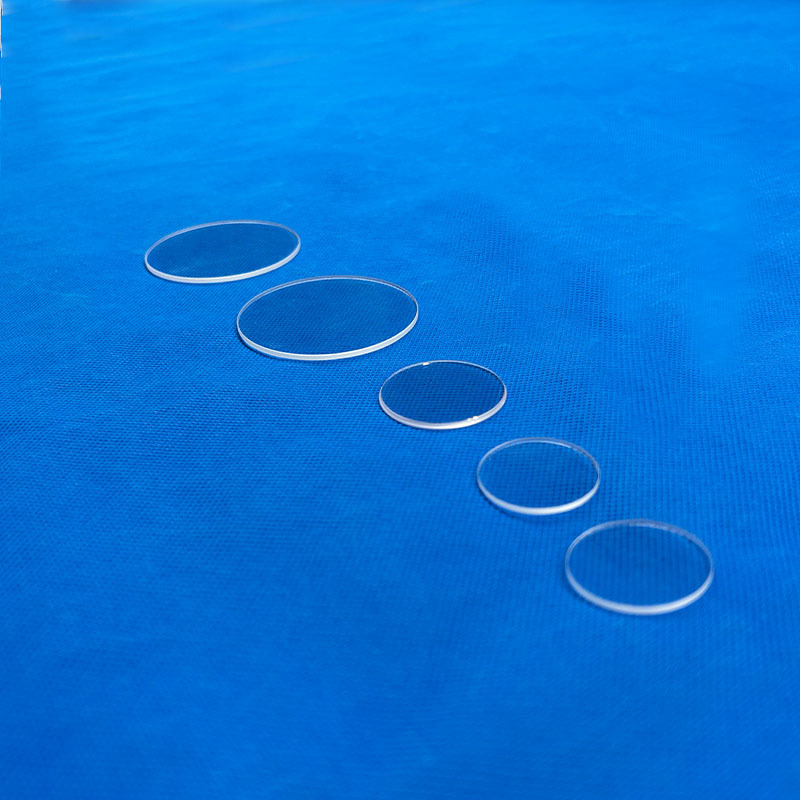
High TransparencyFused Silica Observation Window Disc Quartz Glass Sheet for Singapore Semiconductor-Mia
Published On: July 21, 2026
Project Overview
-
Client: Singapore-based semiconductor vacuum equipment component manufacturer
-
Product: High-purity fused silica observation window discs (circular optical viewport components)
-
Supplier: Lianyungang Shengfan Quartz Products Co., Ltd.
-
Material: High-purity fused silica (SiO₂ purity ≥ 99.99%, low hydroxyl content)
-
Application: Observation windows for vacuum chambers in semiconductor plasma etching and thin-film deposition equipment, used for real-time visual process monitoring and optical inspection
-
Core Processes: Precision quartz disc cutting, double-sided optical-grade lapping and polishing, edge chamfering, dimensional inspection.
Client's Original Pain Points
1. Insufficient Transmittance of Standard Glass Viewports Affecting Process Monitoring Accuracy
The client previously used standard low-iron tempered glass as observation windows for vacuum chambers. Light transmittance dropped sharply in the deep ultraviolet to near-infrared spectrum (particularly below 300nm). This prevented accurate observation of plasma states and wafer surface conditions during processing, compromising the timeliness and accuracy of process parameter adjustments.
2. Thermal Expansion Mismatch Causing High-Temperature Service Failure
Semiconductor etching and deposition processes involve frequent chamber temperature cycling. Standard glass windows have relatively high coefficients of thermal expansion, which do not match that of metal flanges. Under repeated thermal cycling, stress cracks developed, with an average service life of less than 6 months. Frequent replacement increased costs and caused production line downtime.
3. Insufficient Surface Finish Affecting Optical Inspection Accuracy
The client installed optical inspection equipment (spectrometers, laser interferometers) outside the chamber, requiring extremely low surface roughness and high surface figure accuracy. The former supplier's products only met general industrial-grade surface quality (S/D 80/50), with significant scattering losses that degraded signal-to-noise ratios in optical detection.
Our Targeted Solutions & Advantages
1. High-Purity Fused Silica Material with Wide-Band High Transmittance
We selected high-purity fused silica material (SiO₂ ≥ 99.99%) featuring wide-band high transmittance from deep ultraviolet (185nm) to near-infrared (2500nm). Compared to standard glass windows, transmittance in the DUV region is substantially improved, ensuring accuracy and reliability in process monitoring and optical inspection.
2. Low Thermal Expansion Coefficient with Excellent Thermal Cycling Stability
Fused silica's thermal expansion coefficient is only 5.4×10⁻⁷/℃, significantly lower than standard glass. During repeated temperature cycling in semiconductor vacuum chambers, dimensional changes are minimal, providing excellent thermal matching with metal flanges and eliminating stress cracking risks. Service life extends to 3–5 times that of standard glass windows.
3. High Purity, Low Impurity Content Ensuring Vacuum Environment Cleanliness
Select low-hydroxyl fused silica material with metallic impurity content controlled at ppb levels. No outgassing or contamination occurs under high-temperature vacuum conditions, fully satisfying the stringent chamber cleanliness requirements of semiconductor etching and deposition processes.
Cooperation Results & Client Feedback
1. Process Monitoring Accuracy Significantly Enhanced
After adopting high-purity fused silica windows, the client can clearly observe plasma distribution and wafer surface conditions within the chamber during plasma etching processes. Process parameter adjustment timeliness improved by approximately 25%, with wafer yield increasing by about 3%.
2. Window Service Life Substantially Extended
Fused silica windows have been operating continuously in semiconductor vacuum chambers for over 18 months without stress cracks or transmittance degradation—more than 3 times the service life of standard glass windows. Maintenance costs and production line downtime were significantly reduced.
3. Optical Inspection Signal Quality Optimized
Optical-grade surface finish (Ra < 1nm, S/D 40/20) substantially reduces light scattering losses. Signal-to-noise ratios for spectrometers and laser interferometers improved by approximately 40%, providing more precise real-time data support for process control.
4. Stable Recurring Bulk Orders
Following successful trial order of 200 pieces, the client signed an annual framework agreement with average monthly orders of 200–300 pieces. Fused silica observation windows have been incorporated into the client's standard components procurement catalog.

